


Bias and Ambiguity Resolution committee
Established: 2025
Chair: Jianghui Geng
Mailing List: IGS BAR Pilot Project Mailing List
The IGS Bias and Ambiguity Resolution (BAR) Committee is tasked with unifying and standardizing the research, generation, and application of various bias products within the increasingly complex multi-GNSS, multi-frequency environment.
Charter
Over the last decades, several Global Navigation Satellite Systems (GNSS) have been deployed in support of positioning, navigation, and timing (PNT) users, as well as Earth-science applications. Originally, GPS receivers were tracking a limited number of signals/frequencies, whose observables are subject to different satellite biases such as well-known P1-P2 and P1-C1 differential code biases. However, with the introduction of multi-GNSS constellations and multi-frequency tracking receivers, the number of different biases has grown significantly, and their accurate estimation is crucial to future high-integrity and safety-critical applications.
The newly established Bias & Ambiguity Resolution (BAR) committee supersedes and consolidates the former PPP-AR Pilot Project merging with the Bias & Calibration committee. The main objective is to coordinate research, standardisation, validation, and dissemination of bias products relevant for current GNSS and future constellations (e.g., low Earth orbit, LEO). The foreseen activities of the BAR committee have a strong relationship with the clock and ionosphere products. For this reason, it is expected to operate in close collaboration with the Analysis Centre Coordinator (ACC), Real‑Time Service (RTS), Clock committee, and other relevant IGS entities.
Goals and Tasks
The objectives of the BAR committee are divided into three parts. Tasks are defined in continuation of the PPP-AR Pilot Project, integrating fundamental activities carried out by the former Bias & Calibration Committee.
Part 1: harmonization and methodology consolidations
Main activities concern:
- Survey existing bias definitions, network estimation strategies, and formats across individual ACs.
- Consolidate existing observable-specific bias (OSB) conventions to accommodate all bias types, and update SINEX_Bias format if necessary.
- Address issues with datum changes, e.g., at day boundaries, exploiting continuity of the integer carrier phase measurements.
- Assessment of hardware stability, including intra-day variations and potential temperature-dependent effects.
- Definition of a white paperdescribing the status of satellite and station bias products, which shall also provide clear recommendations in preparation of upcoming LEO-PNT systems and/or signals.
Part 2: product interoperability and bias combination
Main activities concern:
- Address issues with availability of satellite products for specific signals and/or frequencies, encouraging and supporting more ACs to estimate multi-GNSS/all-frequency biases.
- Evaluate consistency between code and phase biases, in particular since are often estimated in a cascade approach rather than in a single processing step.
- Cross-validation quality assessment of clocks and biases, and standardize the specification of the product combination statistics in support of ACC and WCC.
- Initiate testing campaigns, open to the community, to evaluate performances and to identify key issues in the combined products.
- Potential development of a clock-bias combination free and open-sourcesoftware toolbox that will be provide to the IGS community.
Part 3: ambiguity resolution and integrity monitoring
Main activities concern:
- Provide best practices for a successful integer-cycle resolution of carrier-phase ambiguities, while defining common misconceptions in the statistical interpretation of ambiguity-fixed solutions.
- Address issues with FDMA-signals, like in GLONASS, due to inter-frequency biases, or in future LEO-PNT systems working on alternative frequency bands, along with potentially accounting for intra-day variations currently neglected (or assumed slowly varying in current systems).
- Establish an integrity monitoring system to detect unmodelled errors and degraded performance during the generation of satellite clock/bias corrections.
Members
The following table contains a list of people who are supporting the BAR committee initiative and willing to contribute products and/or expertise. This list is likely to grow as more people are aware of the committee.
Name |
Institution |
Role |
|---|---|---|
| Jianghui Geng | SKLPG, CAS | Chair |
| Lotfi Massarweh | TU Delft | Vice-chair |
| Yoaz Bar-Sever | JPL | Analysis center contribution |
| Larry Romans | JPL | Analysis center contribution |
| Ant Sibthorpe | JPL | Analysis center contribution |
| Michael Coleman | NRL | Time alignment advisor |
| Qiang Wen | SKLPG, CAS | Analysis center contribution (MGEX rapid) |
| Jing Guo | Wuhan University | Analysis center contribution (MGEX final) |
| Guo Chen | Wuhan University | Orbit combination |
| Yahao Zhang | SKLPG, CAS | Clock/bias combination and web developer |
| Denis Laurichesse | CNES | Analysis center contribution |
| Sylvain Loyer | CLS | Analysis center contribution |
| Benjamin Maennel | GFZ | Analysis center contribution |
| Zhiguo Deng | GFZ | Analysis center contribution |
| Giulio Tagliaferro | BIPM | Clock analysis |
| Jiang Guo | BIPM | Clock analysis |
| Francesco Gini | ESA | Analysis center contribution |
| Erik Schoenemann | ESA | Analysis center contribution |
| Nacho Romero | CSC (@ESA/ESOC) | Analysis center contribution |
| Tim Springer | PosiTim (@ESA/ESOC) | Analysis center contribution |
| Stefan Schaer | CODE | Analysis center contribution |
| Xiang Guo | HUST | Analysis center contribution |
| Simon Banville | NRCan | Analysis center contribution |
| Baocheng Zhang | CAS | Technical analysis |
| Salim Masoumi | GA | Analysis center coordinator (ACC) |
| Patrick Dumitraschkewitz | TU Graz | Analysis center contribution and reference attitude |
Recommended software for PPP-AR product validation
PRIDE PPP-AR (Precise Point Positioning with Ambiguity Resolution): https://github.com/PrideLab/PRIDE-PPPAR/
Formats
| SINEX Bias | Solution INdependent EXchange format for GNSS biases |
| ORBEX | GNSS attitude quaternions |
Publications related to IGS BAR committee activities
Banville S, Geng J, Loyer S, Schaer S, Springer T, Strasser S (2020) On the interoperability of IGS products for precise point positioning with ambiguity resolution. Journal of Geodesy, 94, 1-15. https://doi.org/10.1007/s00190-019-01335-w
Lin J, Geng J, Yan Z, Masoumi S, Zhang Q (2023) Correcting antenna phase center effects to reconcile the code/phase bias products from the third IGS reprocessing campaign. GPS solutions, 27, 70. https://doi.org/10.1007/s10291-023-01405-9
Loyer S, Banville S, Geng J, Strasser S (2021) Exchanging satellite attitude quaternions for improved GNSS data processing consistency. Advances in Space Research, 68, 2441-2452. https://doi.org/10.1016/j.asr.2021.04.049
Strasser S, Banville S, Kvas A, Loyer S, Mayer-Gürr T (2021) Comparison and generalization of GNSS satellite attitude models. EGU General Assembly. https://doi.org/10.5194/egusphere-egu21-7825
IGSMail related to IGS BAR committee activities
IGS Repro3 orbit. clock, bias and attitude solutions available (IGSMAIL-8248)
A new keyword in Bias-SINEX for antenna phase center corrections on geometry-free biases (IGSMAIL-8279)
Special Issue “GNSS Precise Point Positioning: Towards Global Instantaneous cm-Level Accuracy”
A special issue of Remote Sensing (ISSN 2072-4292).
Deadline for manuscript submissions: 31 December 2021
Precise point positioning (PPP) using global navigation satellite systems (GNSS) enables accurate positioning worldwide. Recent advances, including improved error source modeling and the modernization of GNSS constellations, have reduced the time required to achieve cm-level accuracies from hours to seconds, creating new possibilities for several applications.
The objective of this Special Issue is to address the remaining technical challenges associated with global instantaneous high-accuracy GNSS positioning. Timely and reliable positioning can only be achieved through careful attention to detail in all system components, including space segment, signal propagation medium, and receiver design. Research topics of interest include but are not limited to satellite orbit dynamics (solar radiation pressure, attitude), atmospheric augmentation (functional and stochastic models, contribution of low-Earth orbit (LEO) satellites, correction dissemination), and end-user algorithms (stochastic models, time correlation, ambiguity validation). Since integrity plays a critical role in many emerging applications, novel network and end-user techniques for improved error source characterization are also of interest.
I hope that by focusing our efforts on these technical challenges, end-users in a wide range of applications including autonomous vehicles, marine navigation, and many more, can experience fast and accurate positioning globally
For more information: https://www.mdpi.com/journal/remotesensing/special_issues/GNSS_PPP
Centre National d’Etudes Spatiales (CNES) / Navigation Team
Product Line |
Bias SINEX |
Phase Biases |
Start Date |
End Date |
Sampling Rate |
Link |
|---|---|---|---|---|---|---|
| Rapid | Yes | GPS L1/L2/L5 | 2019-001 | 30 S | http://www.ppp-wizard.net/products/POST_PROCESSED/ | |
| Galileo L1/L5/L6/L7 | ||||||
| BDS-2 L2/L6/L7 | ||||||
| BDS-3 L1/L2/L5/L6/L7 | ||||||
| Real time | Yes | GPS L1/L2/L5 | 2019-001 | 30 S | http://www.ppp-wizard.net/products/REAL_TIME/ | |
| Galileo L1/L5/L6/L7 | ||||||
| BDS-2 L2/L6/L7 | ||||||
| BDS-3 L2/L6/L7 |
Center for Orbit Determination in Europe (CODE) [COD]
Product Line |
Bias SINEX |
Phase Biases |
Start Date |
End Date |
Sampling Rate |
Link |
|---|---|---|---|---|---|---|
| Rapid | Yes | GPS L1/L2 | 2019-001 | 1 D | http://ftp.aiub.unibe.ch/CODE/yyyy_M/ https://cddis.nasa.gov/archive/gnss/products/wwww/ |
|
| Galileo L1/L5 | 2019-272 | 1 D | ||||
| Final | Yes | GPS L1/L2 | 2019-001 | 1 D | http://ftp.aiub.unibe.ch/CODE/yyyy/ https://cddis.nasa.gov/archive/gnss/products/wwww/ |
|
| Galileo L1/L5 | 2019-272 | 1 D | ||||
| MGEX | Yes | GPS L1/L2 | 2018-182 | 1 D | http://ftp.aiub.unibe.ch/CODE_MGEX/CODE/yyyy/ https://cddis.nasa.gov/archive/gnss/products/wwww/ |
|
| Galileo L1/L5 | ||||||
| QZSS L1/L2 | 2024-126 | 1 D | ||||
| Repro3 | Yes | GPS L1/L2 | 2000-124 | 2022-330 | 1 D | http://ftp.aiub.unibe.ch/REPRO_2020/CODE/yyyy/ https://cddis.nasa.gov/archive/gnss/products/wwww/repro3/ |
| Galileo L1/L5 | 2014-001 | 2022-330 | 1 D |
Natural Resources Canada (NRCan) [EMR]
Product Line |
Bias SINEX |
Phase Biases |
Start Date |
End Date |
Sampling Rate |
Link |
|---|---|---|---|---|---|---|
| Repro3 | Yes | GPS L1/L2 | 2000-001 | 2020-366 | 1 D | https://cddis.nasa.gov/archive/gnss/products/wwww/repro3/ |
| Final | Yes | GPS L1/L2 | 2025-124 | 1 D | https://cddis.nasa.gov/archive/gnss/products/wwww/ |
German Research Center for Geosciences (GFZ) [GFZ]
Product Line |
Bias SINEX |
Phase Biases |
Start Date |
End Date |
Sampling Rate |
Link |
|---|---|---|---|---|---|---|
| MGEX | No | GPS WL L1/L2 | 2021-167 | 2021-189 | 1 D | ftp://ftp.gfz-potsdam.de/pub/GNSS/products/mgex/wwww/ |
| Galileo WL L1/L5 | ||||||
| BDS-2 WL L2/L6 | ||||||
| BDS-3 WL L2/L6 | ||||||
| Yes | GPS L1/L2 | 2021-190 | 1 D | https://cddis.nasa.gov/archive/gnss/products/wwww/ | ||
| Galileo L1/L5 | ||||||
| BDS-2 L2/L6 | ||||||
| BDS-3 L2/L6 |
Centre National d’Etudes Spatiales (CNES) / Collecte Localisation Satellites (CLS) [GRG]
Huazhong University of Science and Technology [HUS]
Product Line |
Bias SINEX |
Phase Biases |
Start Date |
End Date |
Sampling Rate |
Link |
|---|---|---|---|---|---|---|
| MGEX (Rapid) | Yes | GPS L1/L2 | 2024-286 | 1 D | ftp://ggda.ac.cn/pub/mgex/products/yyyy | |
| Galileo L1/L5 | ||||||
| BDS-2 L2/L6 | ||||||
| BDS-3 L2/L6 | ||||||
| MGEX (Final) | Yes | GPS L1/L2 | 2024-284 | 1 D | ftp://ggda.ac.cn/pub/mgex/products/yyyy | |
| Galileo L1/L5 | ||||||
| BDS-2 L2/L6 | ||||||
| BDS-3 L2/L6 |
Graz University of Technology [TUG]
Product Line |
Bias SINEX |
Phase Biases |
Start Date |
End Date |
Sampling Rate |
Link |
|---|---|---|---|---|---|---|
| Repro3 | Yes | GPS L1/L2 | 1994-001 | 2020-366 | 1 D | https://cddis.nasa.gov/archive/gnss/products/wwww/repro3/ |
| GPS L5 | 2010-240 | 2020-366 | 1 D | |||
| Galileo L1/L5/L7/L8 | 2013-001 | 2020-366 | 1 D |
Wuhan University [WUM]
Product Line |
Bias SINEX |
Phase Biases |
Start Date |
End Date |
Sampling Rate |
Link |
|---|---|---|---|---|---|---|
| MGEX (Rapid) | Yes | GPS L1/L2/L5 | 2020-001 | 1 D | ftps://bdspride.com/wum/wwww/ ftp://igs.gnsswhu.cn/pub/whu/phasebias/ |
|
| Galileo L1/L5/L6/L7/L8 | ||||||
| BDS-2 L2/L6/L7 | ||||||
| BDS-3 L1/L2/L5/L6/L7 | ||||||
| MGEX (Final) | Yes | GPS L1/L2 | 2023-163 | 1 D | https://cddis.nasa.gov/archive/gnss/products/wwww/ | |
| Galileo L1/L5 | ||||||
| BDS-2 L2/L6 | ||||||
| BDS-3 L2/L6 | ||||||
| Real time | Yes | GPS L1/L2/L5 | 2023-329 | 300 S | ftp://igs.gnsswhu.cn/pub/whu/phasebias/ ntrip.gnsslab.cn:2101, OSBC00WHU1 |
|
| Galileo L1/L5/L6/L7/L8 | ||||||
| BDS-2 L2/L6/L7 | ||||||
| BDS-3 L1/L2/L5/L6/L7 |
2021-09-16
Meeting to discuss the impact of phase center offsets on bias computation.
Summary: PPPAR-WG_20210916_Summary.pdf
Presentation: PPPAR-WG_20210916_Presentation1.pdf
2022-06-30—2022-08-16
Email communications to discuss a new keyword in Bias-SINEX denoting APC corrections.
IGS Mail announcement: IGSMAIL-8279
2023-11-14
Virtual meeting to discuss a new charter and the webpages showing the combination results, etc.
Summary: PPPAR-WG_20231114_Summary.pdf
Presentation: PPPAR-WG_20231114_Presentation.pdf
2024-11-27
Virtual meeting to discuss some technical issues related to the quality, consistency of current PPP-AR products, as well as the one-year routine PPP-AR combination results.
Summary: PPPAR-WG_20241127_Summary.pdf
Presentation:
PPPAR-WG_20241127_Presentation.pdf
One-year routine PPP-AR combination results.pdf
2025-10-29
Virtual meeting to discuss the draft charter and key points for the official establishment of the IGS BAR committee.
Summary: Minute of BAR KOM. pdf
Presentation:
PPP-AR Virtual Meeting 0ct29th-2025 v3.pdf
BAR_Kickoff_HighRateDcB_steigenb.pdf
BIPM.pdf
Combination and analysis of rapid products
The rapid clock and phase bias products provided by different ACs are combined and evaluated.
These products are accessed from the CDDIS archive (https://cddis.nasa.gov/archive/gnss/products/) and the corresponding ACs are listed in the following table. Currently this combination and analysis are only applied to the GPS, Galileo and BDS since the phase bias products provided by ACs are available for these constellations. And other systems are not included in the analysis at this stage.
ID |
Rapid | |||||||||
|---|---|---|---|---|---|---|---|---|---|---|
| name | system | orbit | clock | attitude | code bias | phase bias | APC model | |||
| COD | COD0OPSRAP | GE | 300 s | 30 s | 30 s | GE (OSB) | GE (OSB) | applied | ||
| EMR | EMR0OPSRAP | G | 900 s | 300 s | ||||||
| ESA | ESA0OPSRAP | G | 300 s | 30 s | ||||||
| GFZ | GFZ0MGXRAP | GEC | 300 s | 30 s | 30 s | GEC (OSB) | GEC (OSB) | applied | ||
| GRG | GRG0OPSRAP | GEC | 300 s | 30 s | 30 s | GEC (OSB) | GEC (OSB) | applied | ||
| HUS | HUS0MGXRAP | GEC | 300 s | 30 s | 30 s | GEC (OSB) | GEC (OSB) | applied | ||
| IGS | IGS0OPSRAP | G | 900 s | 300 s | ||||||
| JGX | JGX0OPSRAP | GE | 300 s | 30 s | ||||||
| JPL | JPL0OPSRAP | GE | 300 s | 30 s | 30 s | |||||
| USN | USN0OPSRAP | G | 900 s | 300 s | ||||||
| WUM | WUM0MGXRAP | GEC | 300 s | 30 s | 30 s | GEC (OSB) | GEC (OSB) | applied | ||
| Note: a. In the combination and analysis, rapid products from AC are represented using their ID + “r”, e.g. “CODr” is for the rapid products from COD. b. GEC stand for GPS, Galileo and BDS-2/3 respectively. c. OSB stands for observable specific bias, IRC stands for integer recovery clock. |
||||||||||
Evaluation of combined results
For the methods used in the clock and bias combination, please refer to the tabs Resources.
All the products in the table are included in the combination except for the IGS products, which is used for comparison. The reference orbit products are generated from the Wuhan University and the reference attitude is generated by the open source software GROOPS. The GNSS rapid clock products are combined with a sampling interval of 30 s. All the results are presented on a weekly basis, with a latency of one week.
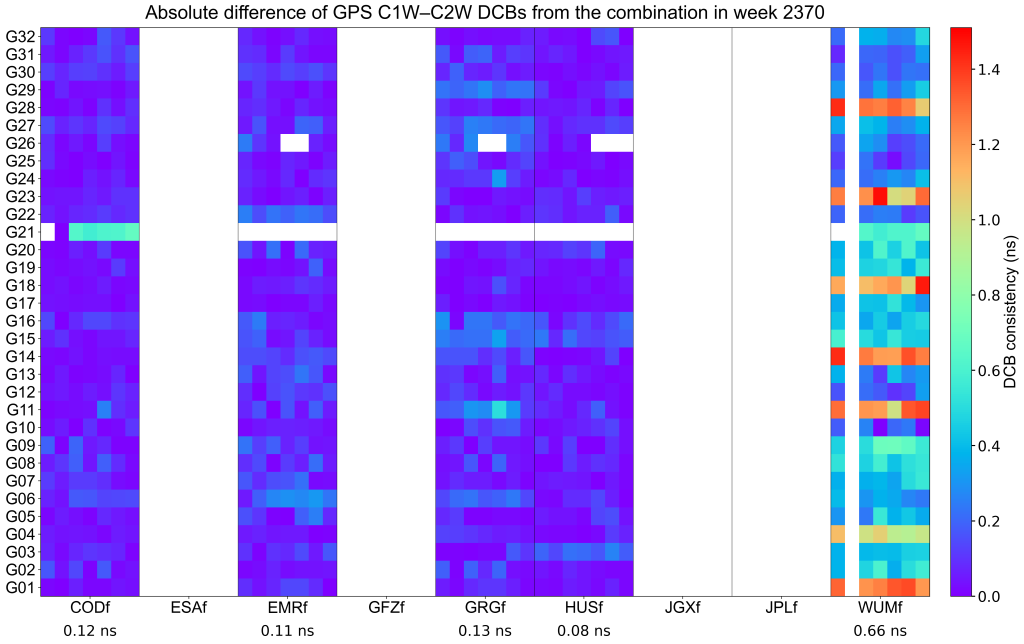
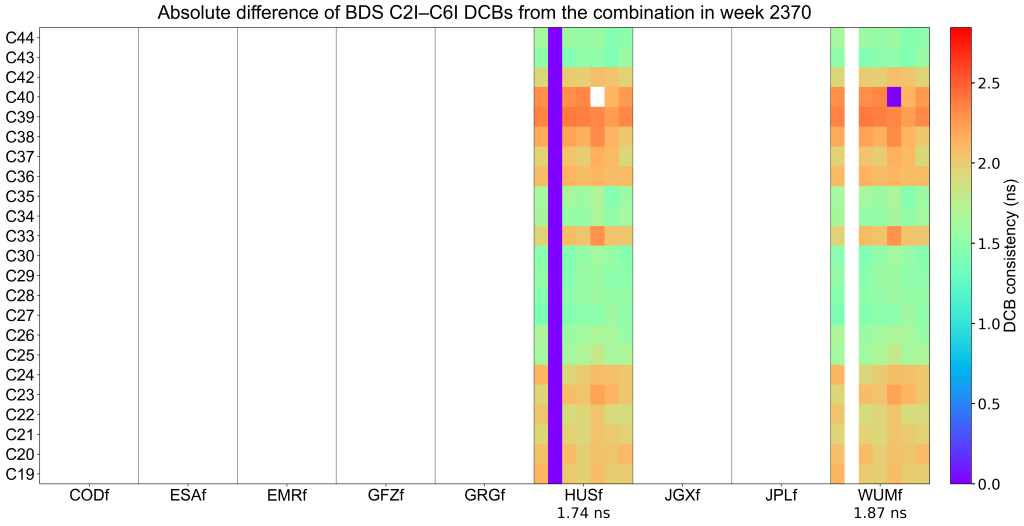
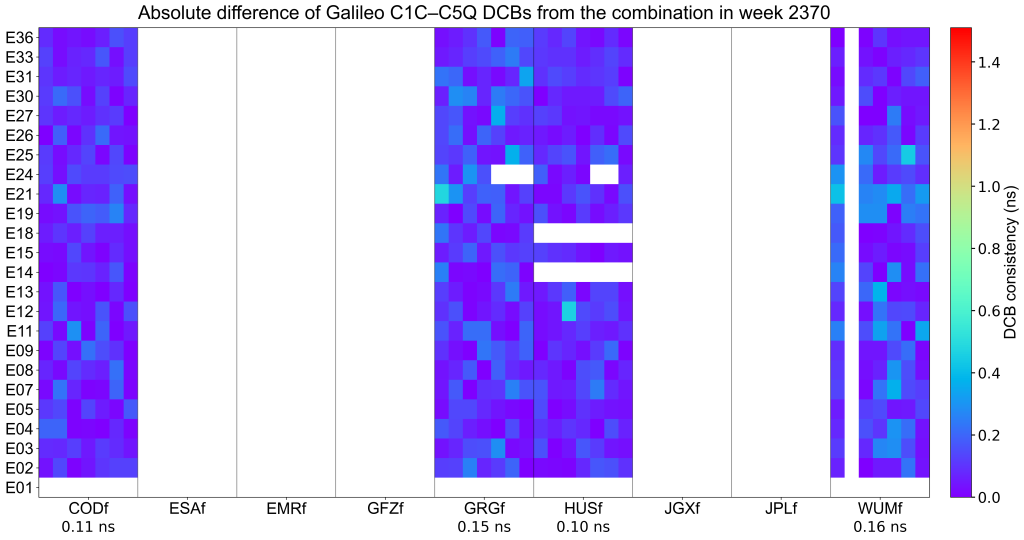
The DCB combination
The DCB combination computes the mean values over all AC contributions. The color scale reflects the consistency of among AC specific DCBs. Each grid represents a satellite on a particular day.
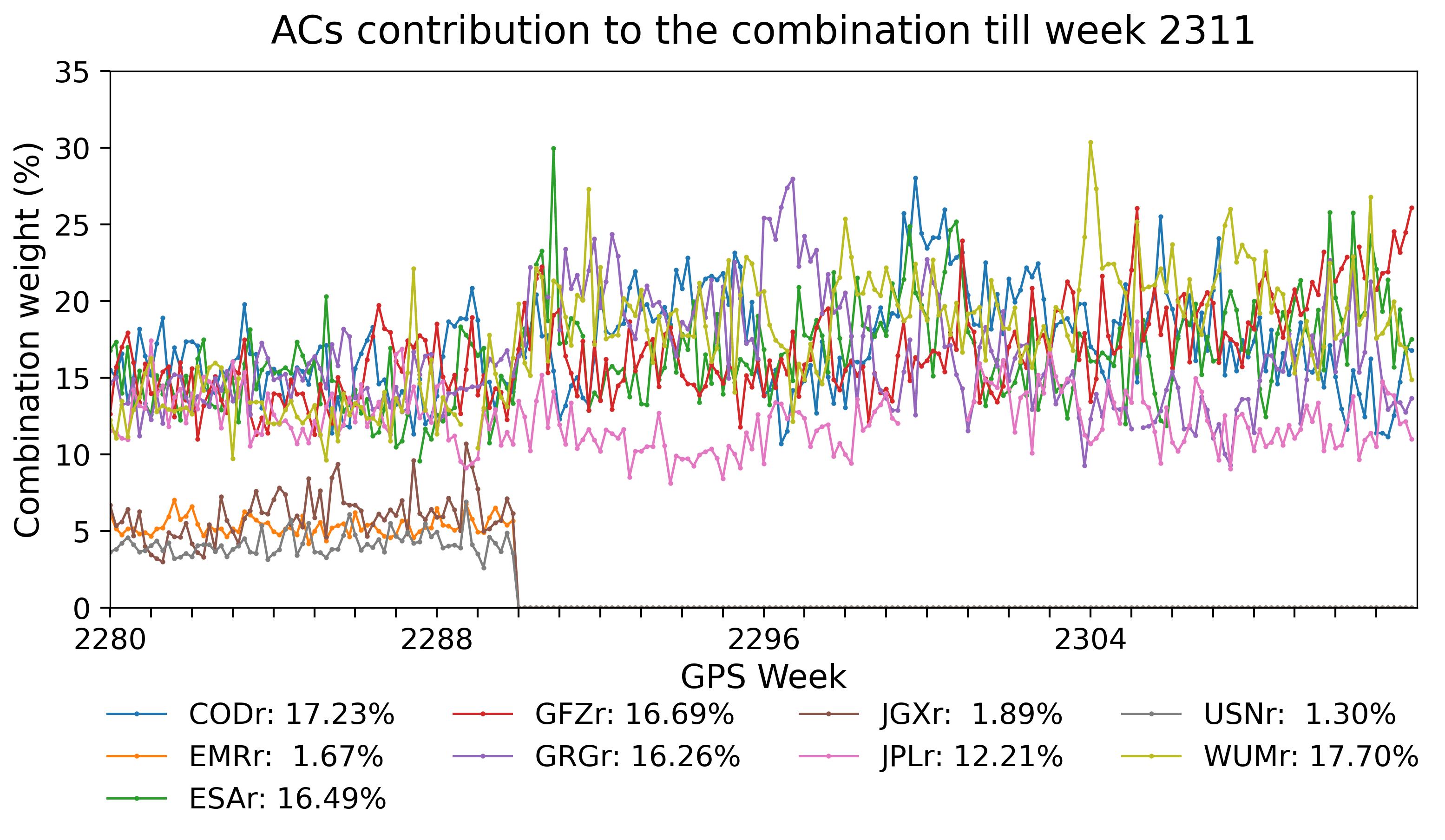
The combination weight
The clock combination employs an iterative weighting method in which the weight assigned to a specific product depends on its residuals in relation to the combined clock.
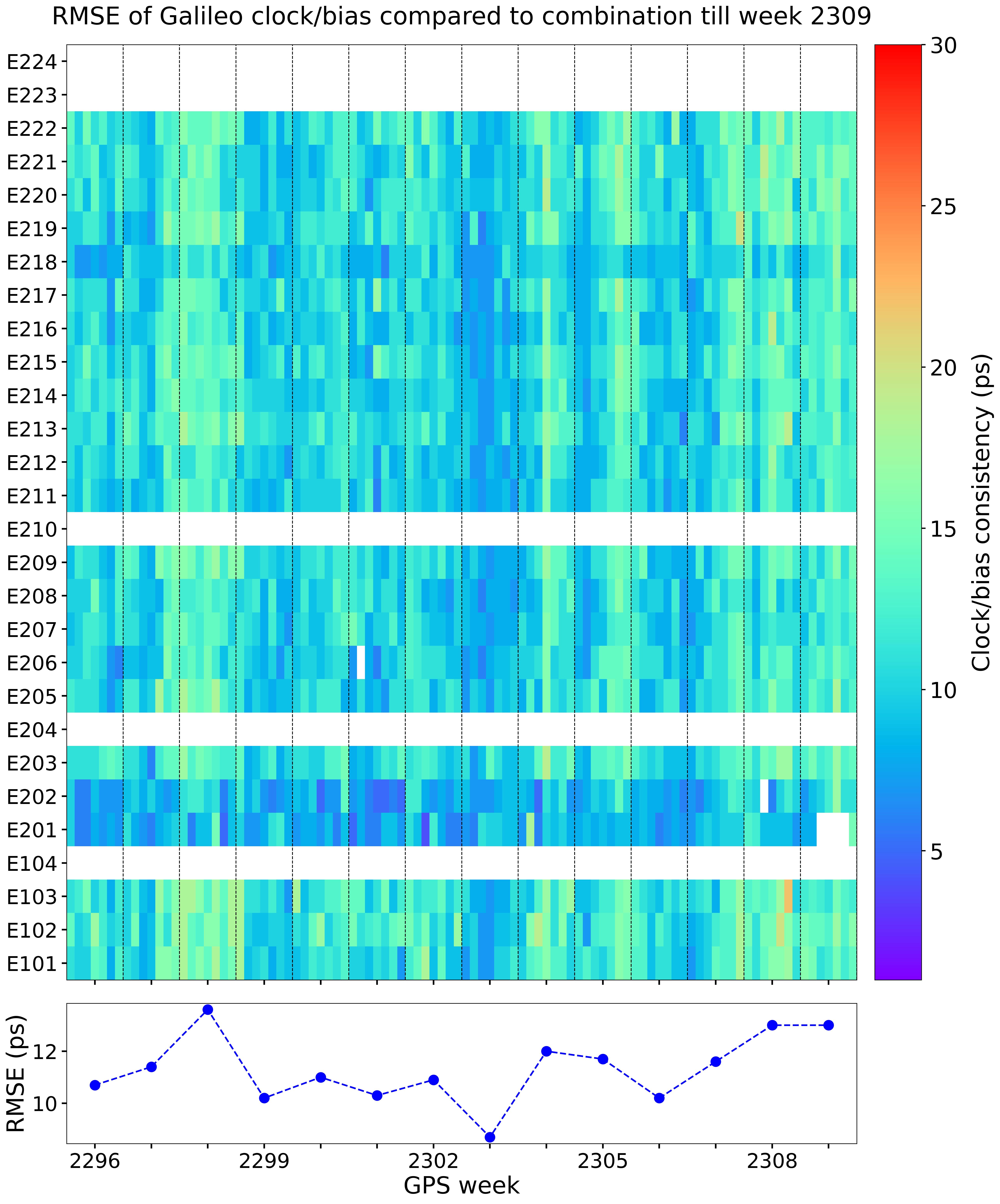
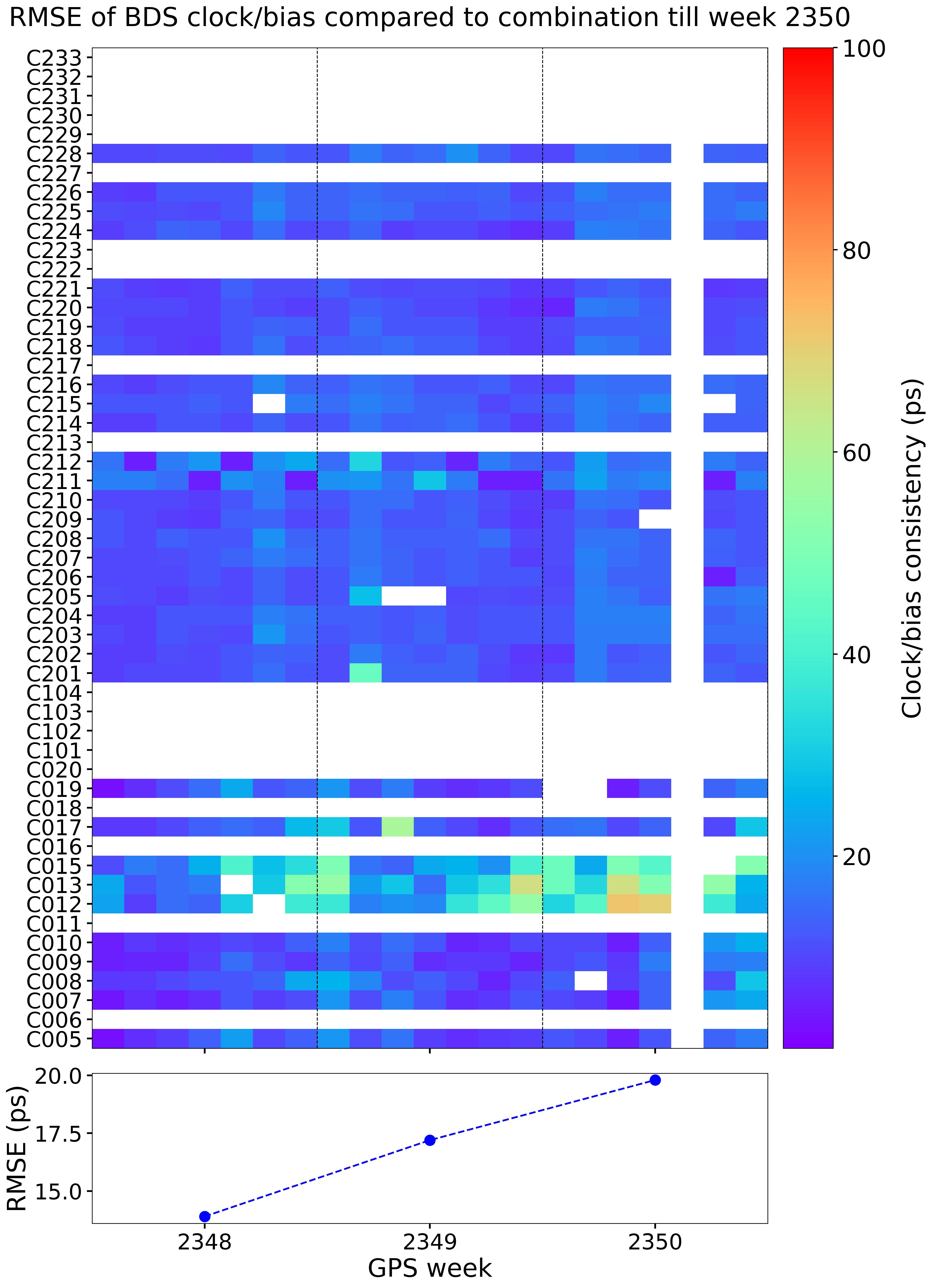
The weekly clock/bias RMSE
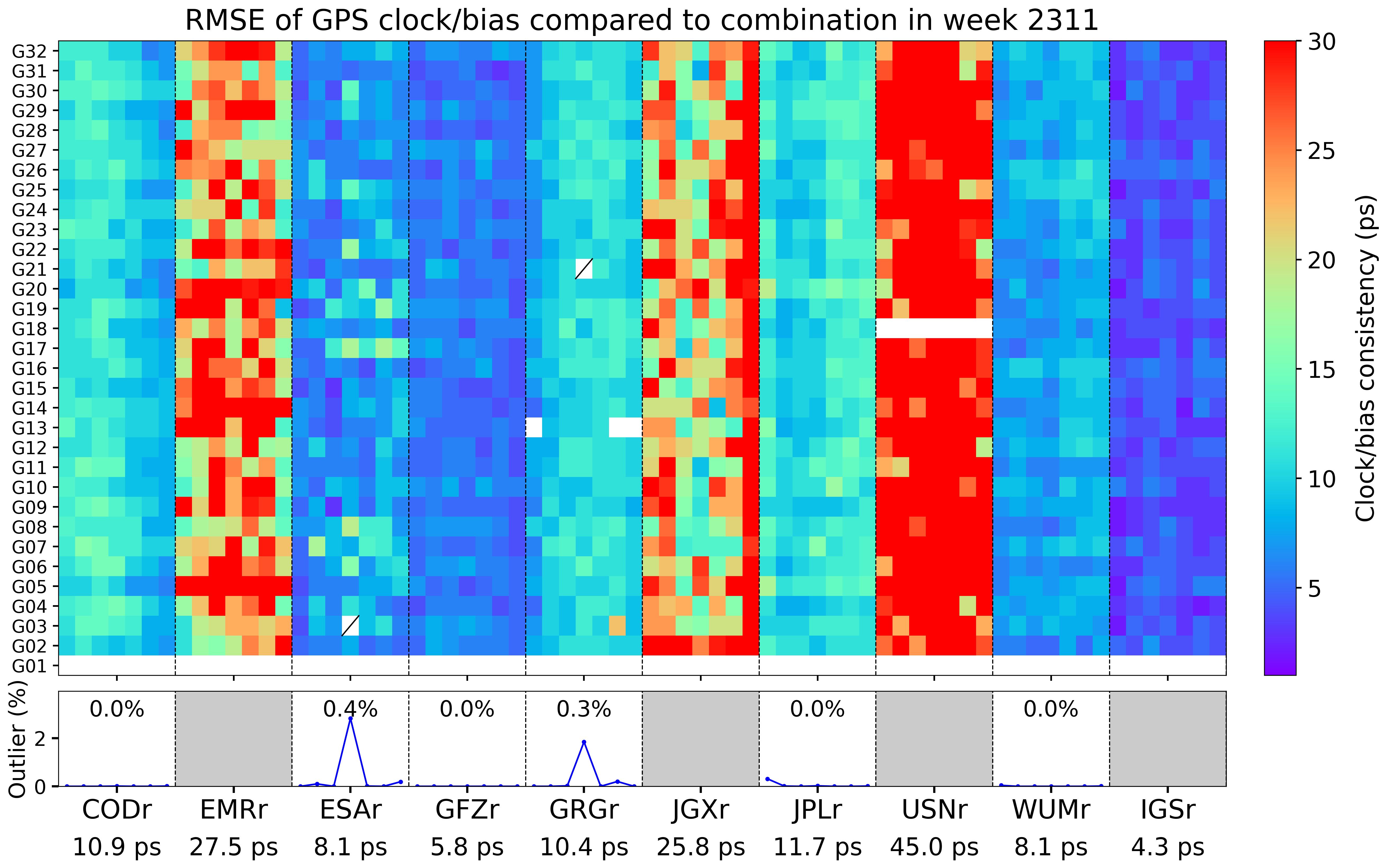
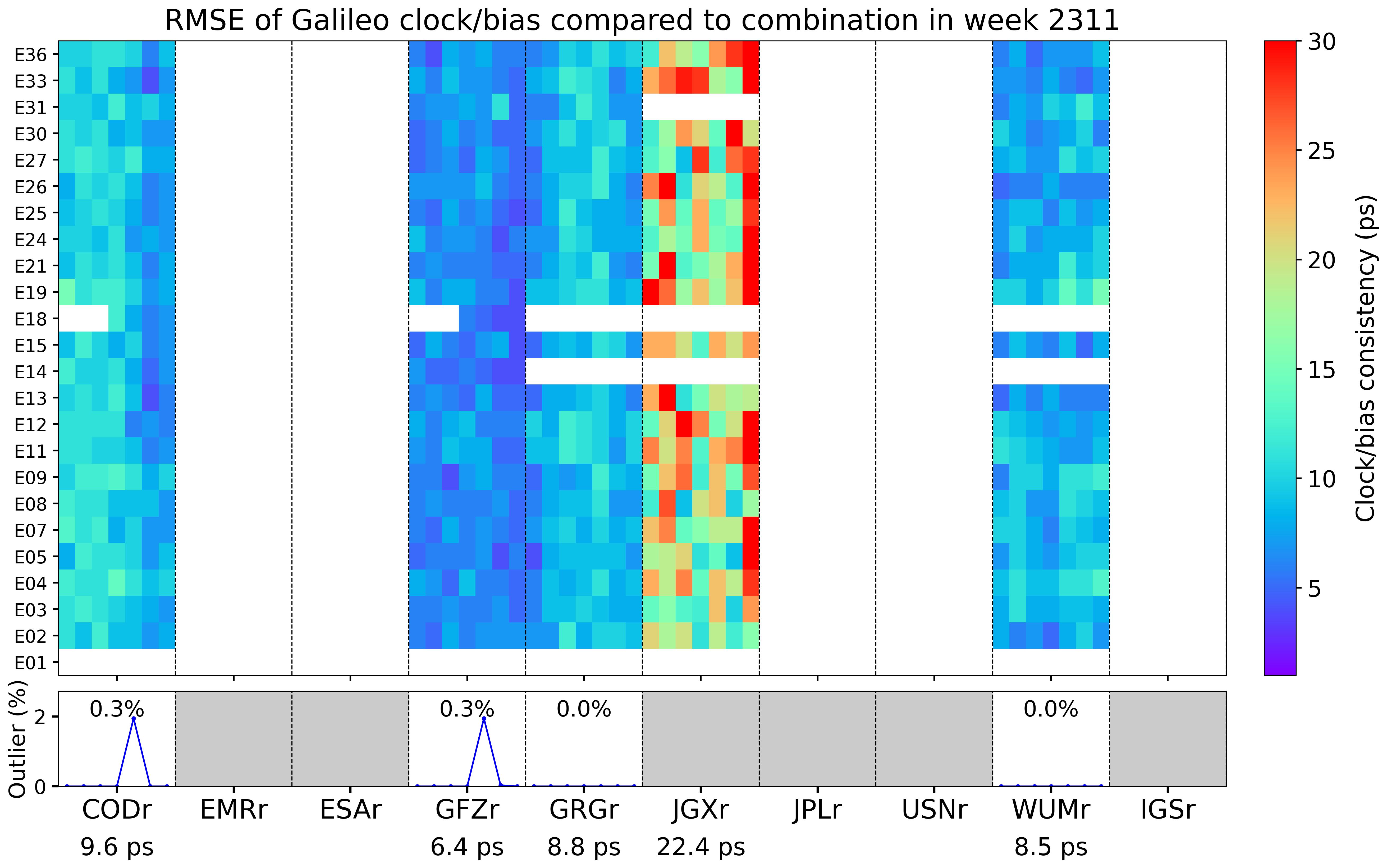
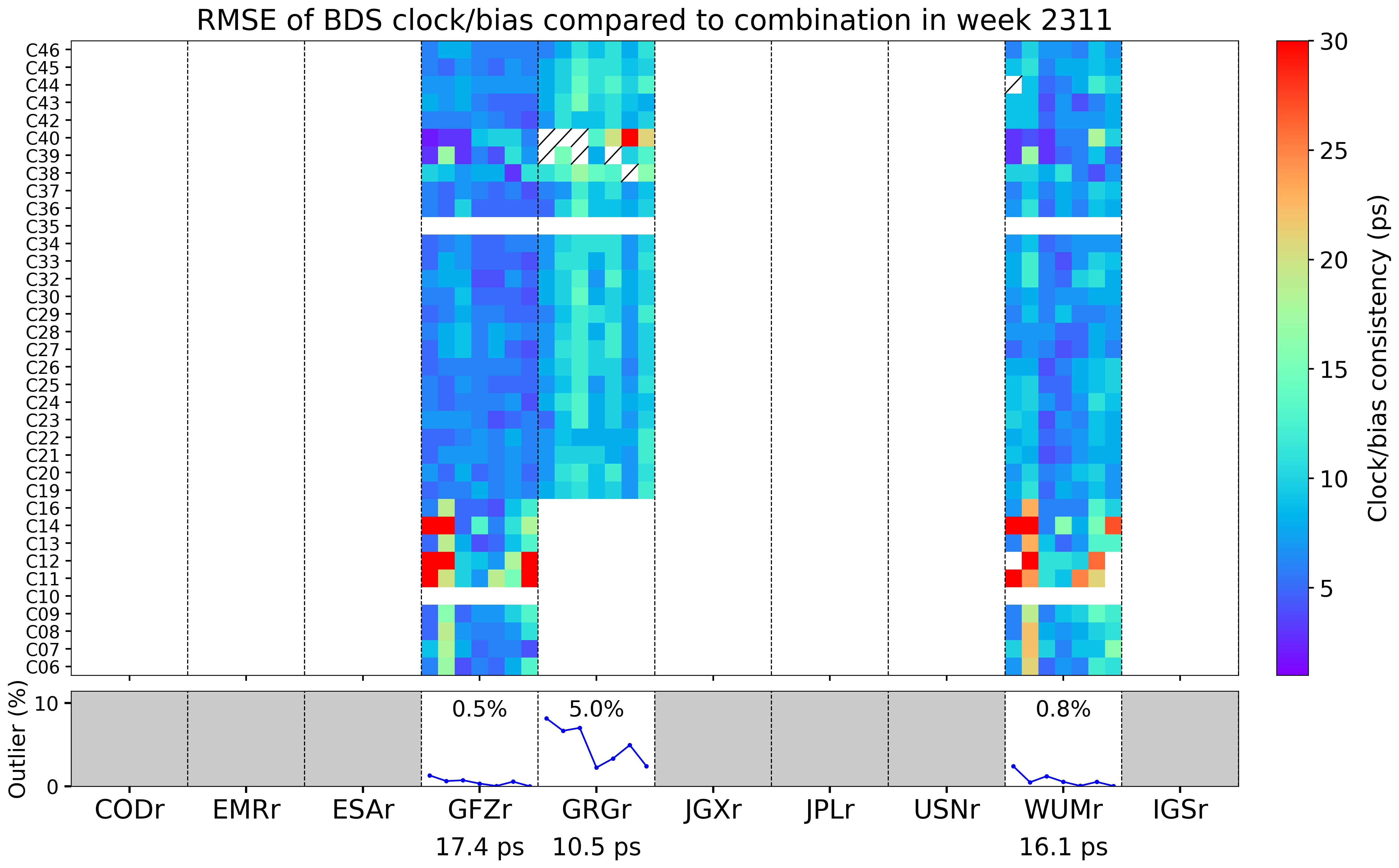
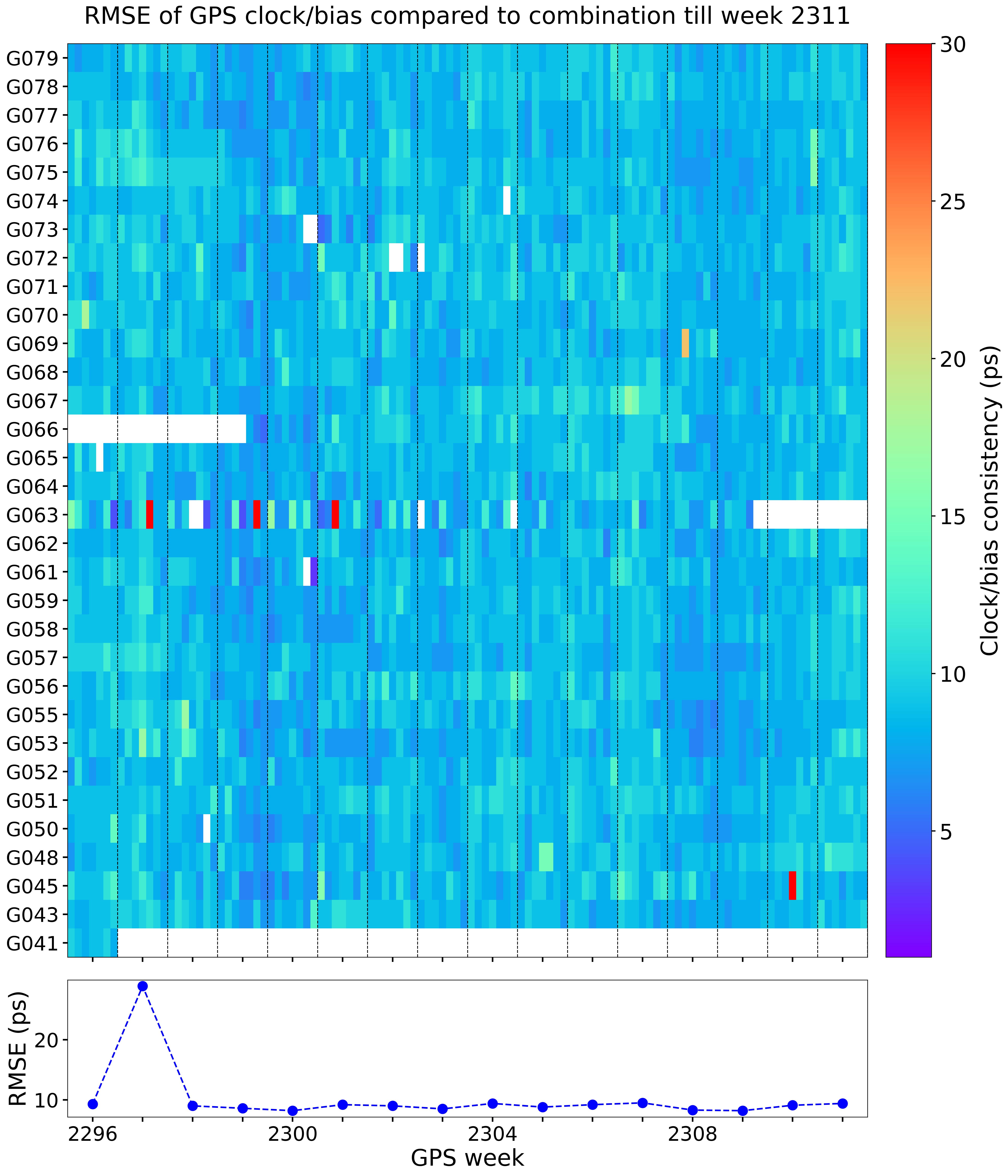
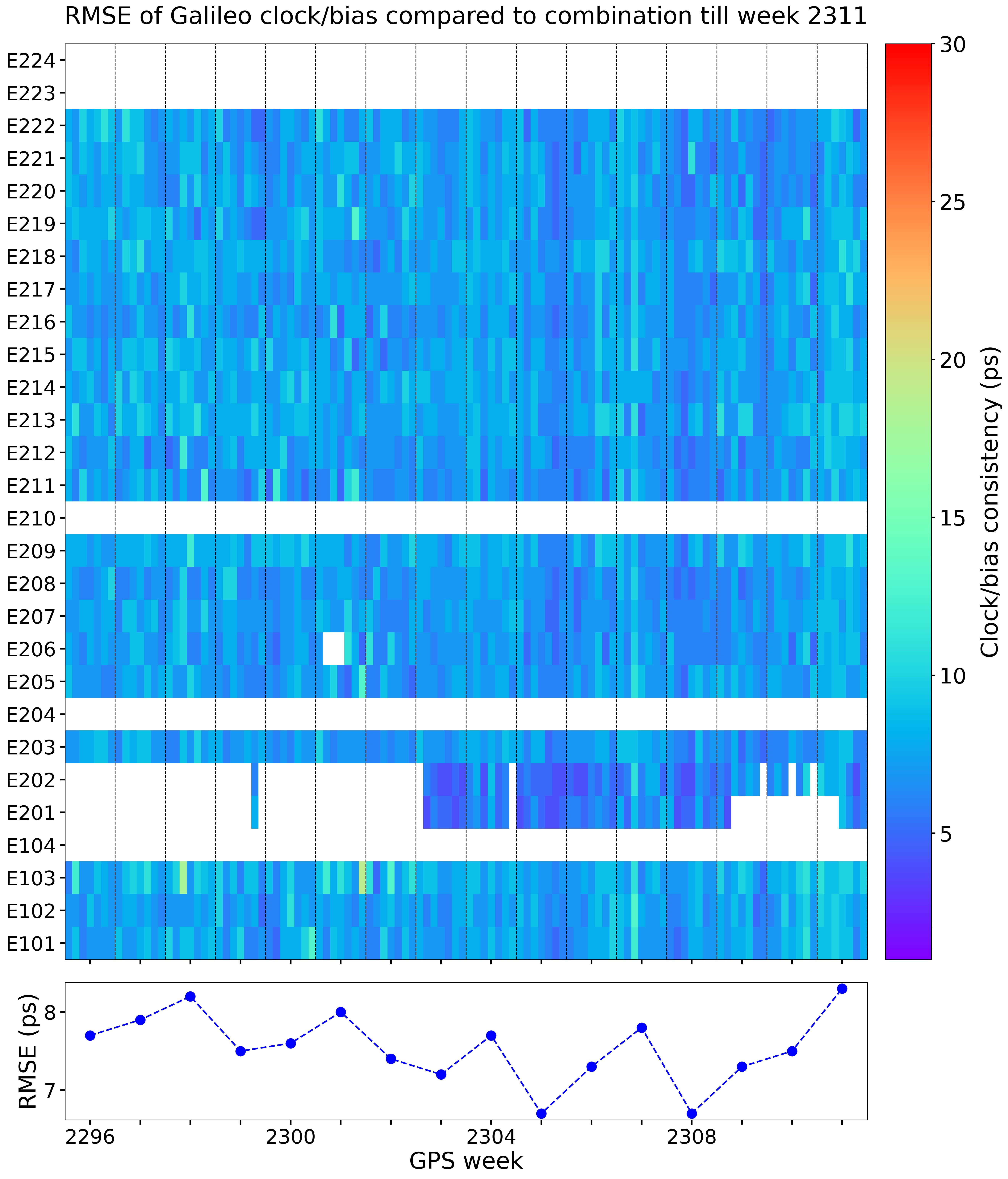
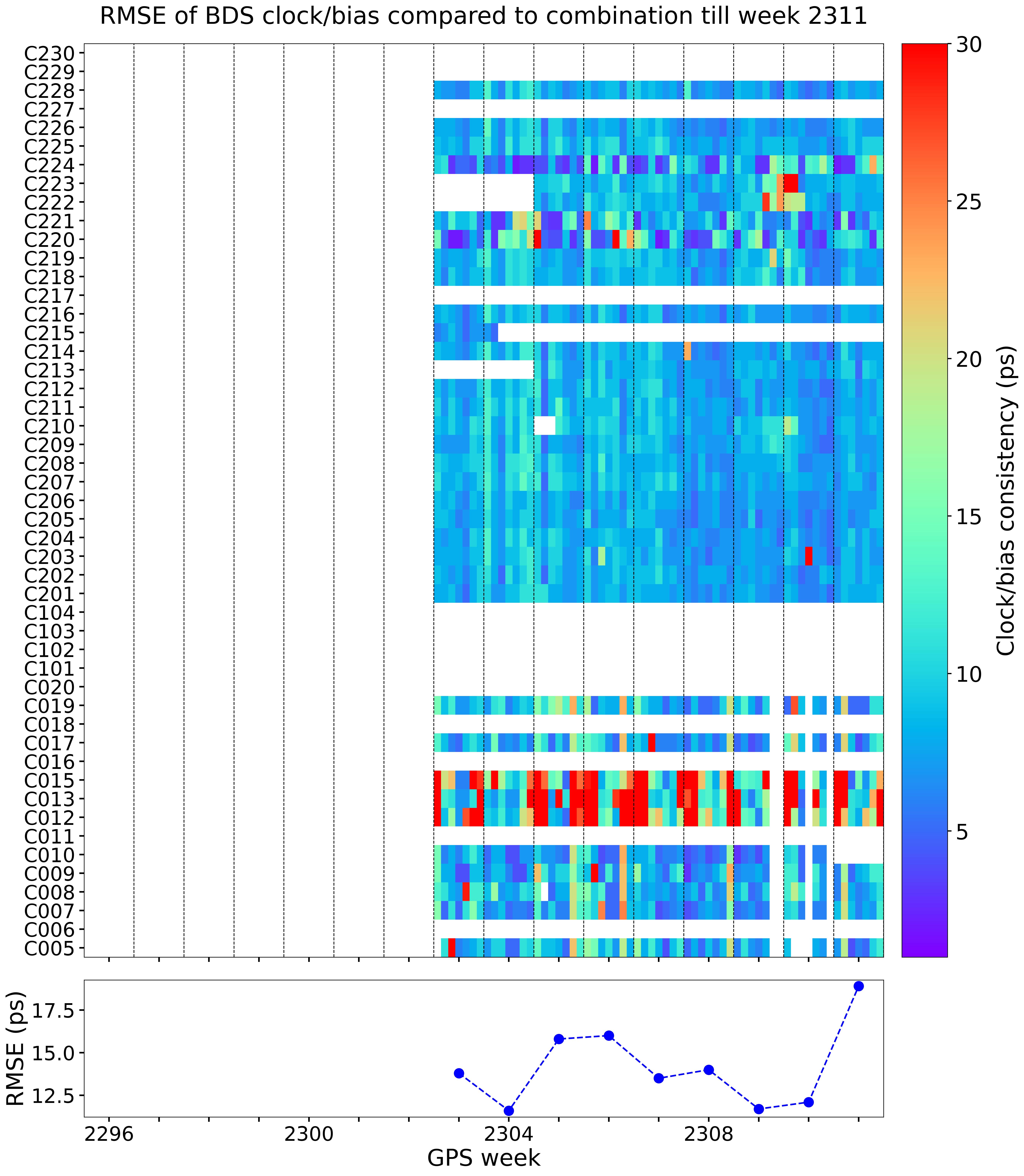
The clock/bias RMSE refers to the daily RMSE of clock/bias for each AC with respect to the combined integer clock, which reflects the precision of clock and bias combination and the consistency between individual ACs. Each grid represents a satellite on a particular day. Blank grids mean unavailable products and a slash inside means an outlier excluded from the combination. The line chart below shows the satellite clock outlier rate per day for each AC, with gray block indicating that relevant satellite clocks do not participate in the comparison. The statistics at the bottom indicate the overall RMSE of AC clock/bias for this week.
The accumulated clock/bias RMSE
The accumulated clock/bias RMSE refers to the daily RMSE of clock/bias for all the ACs with respect to the combined integer clock, which reflects the change of the combined accuracy over time. The line chart below shows the overall RMSE for each constellation.
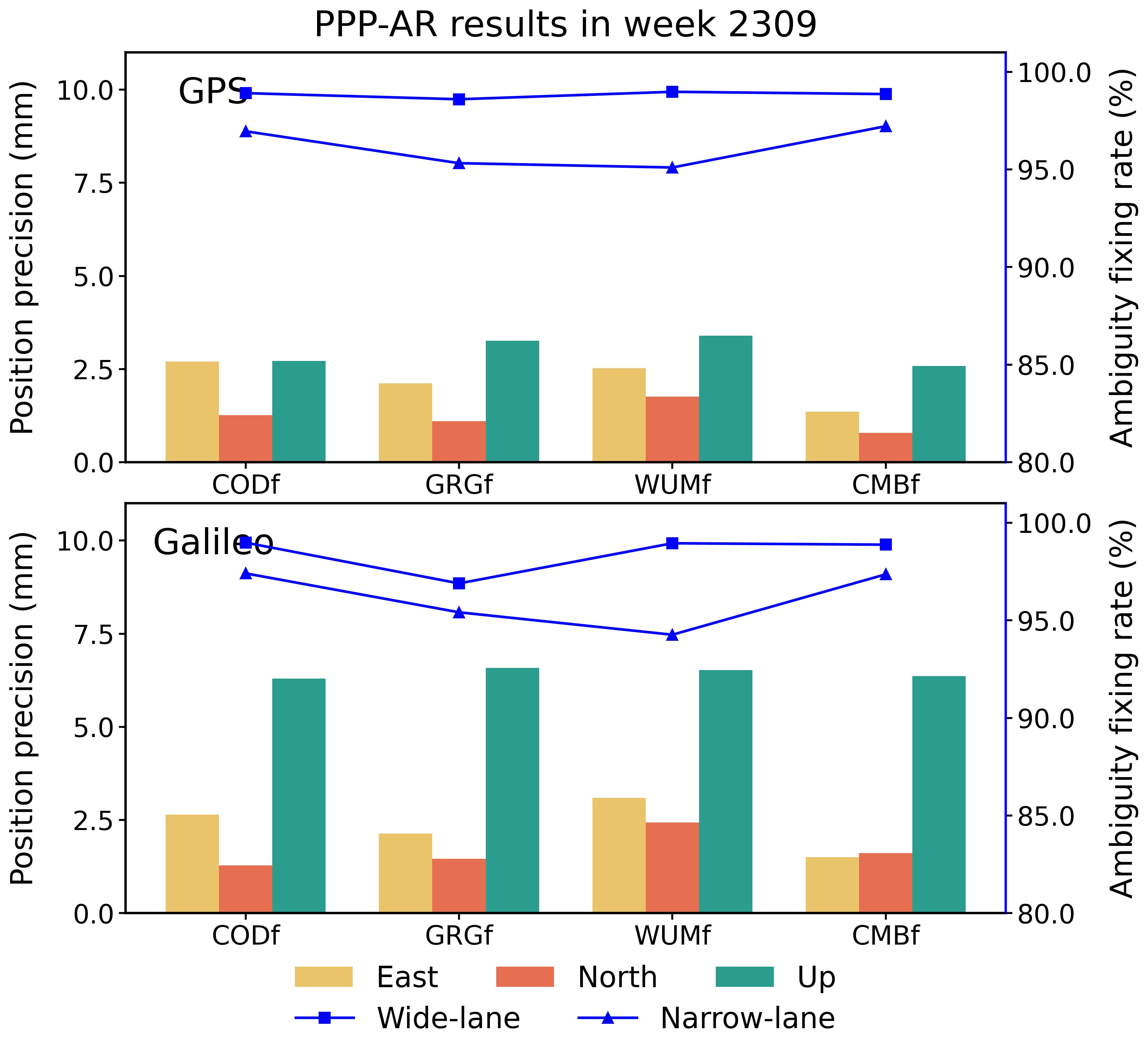
PPP-AR validation
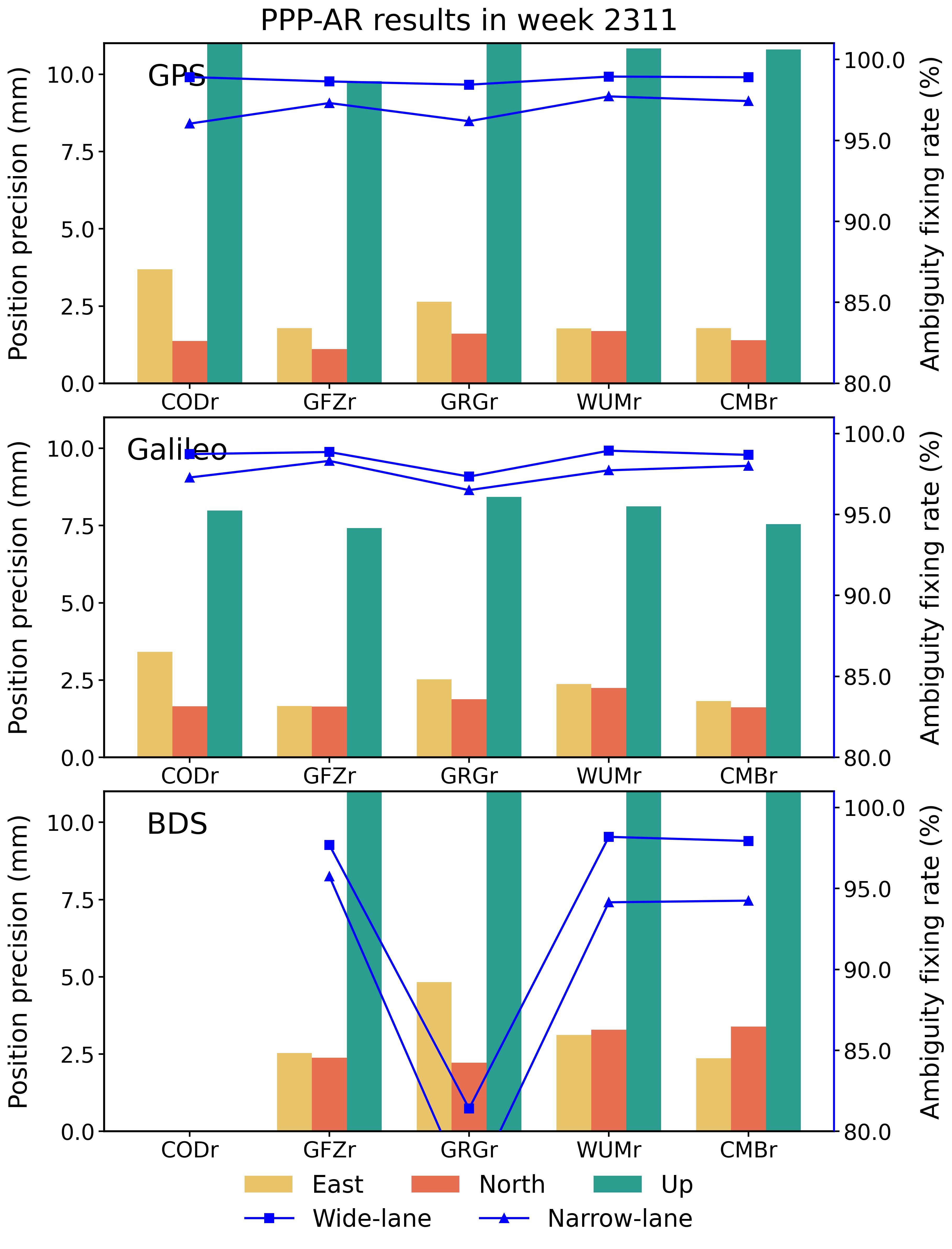
The GPS/Galileo/BDS data with a sampling interval of 300 s from 10 globally distributed stations are processed for PPP-AR in a static mode with the PRIDE PPP-AR software. The fixing rate and position precision of each single constellation solution are presented in the figure below. IGS daily SINEX products are used as reference solution. “CMBr” stands for the combined rapid products.
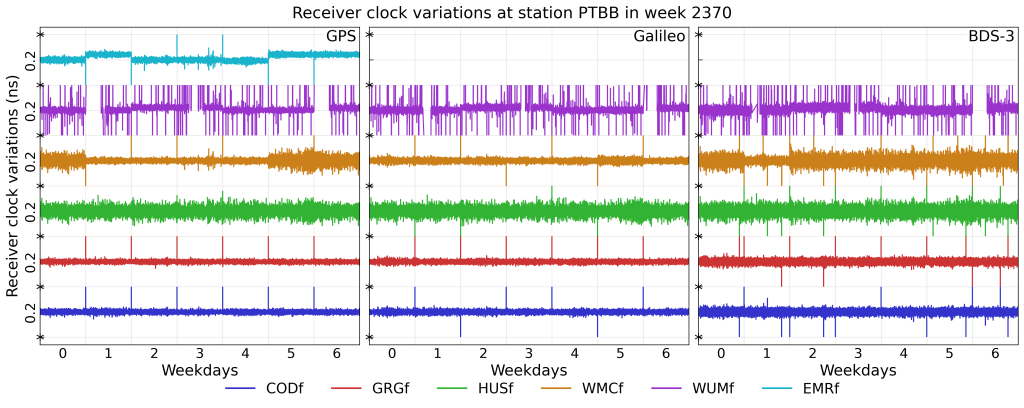
Receiver atomic clocks
The epoch-to-epoch differences of receiver clock offsets represent the variation of receiver clocks between two consecutive epochs, which directly reflects the clock stability. The polyline segments in different colors represent different ACs, and “CMBr” stands for the combined products.
Combination and analysis of final products
The final clock and phase bias products provided by different ACs are combined and evaluated.
These products are accessed from the CDDIS archive (https://cddis.nasa.gov/archive/gnss/products/) and the corresponding ACs are listed in the following table. Currently this combination and analysis are only applied to the GPS, Galileo and BDS since the phase bias products provided by ACs are available for these constellations. And other systems are not included in the analysis at this stage.
ID |
Final | |||||||||
|---|---|---|---|---|---|---|---|---|---|---|
| name | system | orbit | clock | attitude | code bias | phase bias | APC model | |||
| COD | COD0OPSFIN | GE | 300 s | 30 s | 30 s | GE (OSB) | GE (OSB) | applied | ||
| ESA | ESA0OPSFIN | GEC | 300 s | 30 s | ||||||
| GFZ | GFZ0OPSFIN | GE | 300 s | 30 s | ||||||
| GRG | GRG0MGXFIN | GEC | 300 s | 30 s | 30 s | GEC (OSB) | GEC (OSB) | applied | ||
| HUS | HUS0MGXFIN | GEC | 300 s | 30 s | 30 s | GEC (OSB) | GEC (OSB) | applied | ||
| IGS | IGS0OPSFIN | G | 900 s | 30 s | ||||||
| JAX | JAX0MGXFIN | GE | 300 s | 30 s | ||||||
| JGX | JGX0OPSFIN | GE | 300 s | 30 s | ||||||
| JPL | JPL0OPSFIN | GE | 300 s | 30 s | 30 s | |||||
| WUM | WUM0MGXFIN | GEC | 300 s | 30 s | 30 s | GEC (OSB) | GEC (OSB) | applied | ||
| Note: a. In the combination and analysis, final products from AC are represented using their ID + “f”, e.g., “CODf” is for the final products from COD. b. GEC stand for GPS, Galileo and BDS-2/3 respectively. c. OSB stands for observable specific bias, IRC stands for integer recovery clock. d. The GRG BDS bias products are provided for the B1C/B2a frequency signals, while those from other AC are for B1I/B3I. |
||||||||||
Evaluation of combined results
For the methods used in the clock and bias combination, please refer to the tabs Resources.
All the products in the table are included in the combination except for the IGS products, which is used for comparison. The reference orbit products are generated from the Wuhan University and the reference attitude is generated by the open source software GROOPS. The GNSS final clock products are combined with a sampling interval of 30 s. All the results are presented on a weekly basis, with a latency of three weeks.
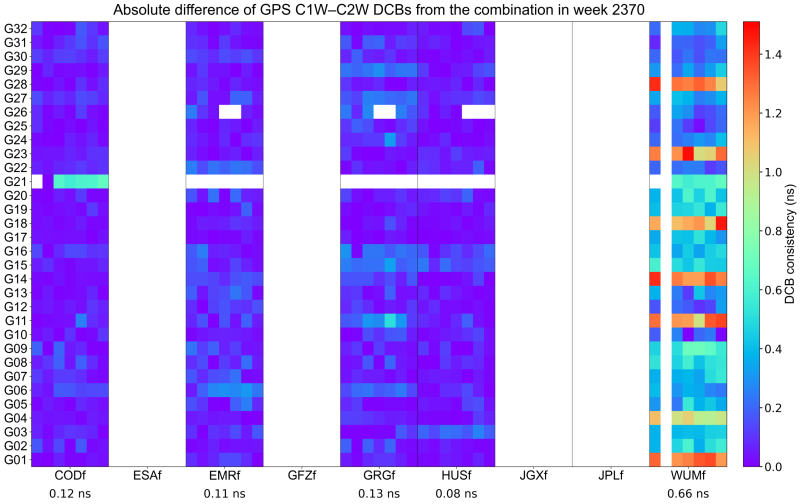
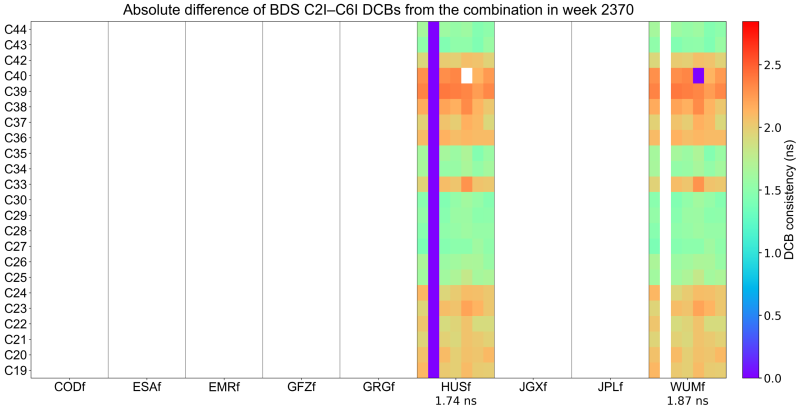
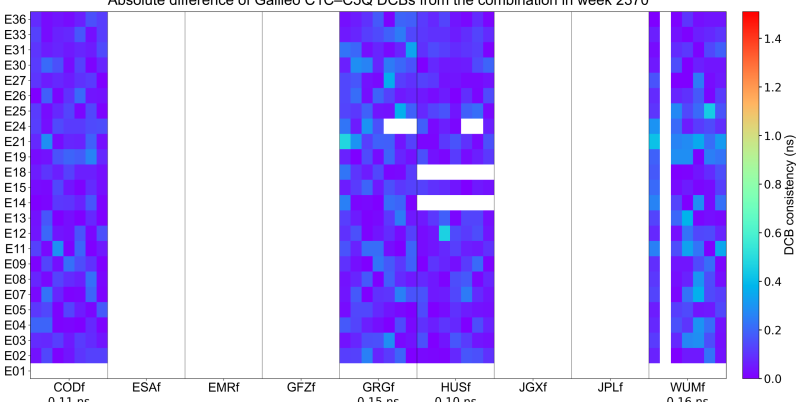
The DCB combination
The DCB combination computes the mean values over all AC contributions. The color scale reflects the consistency of among AC specific DCBs. Each grid represents a satellite on a particular day.
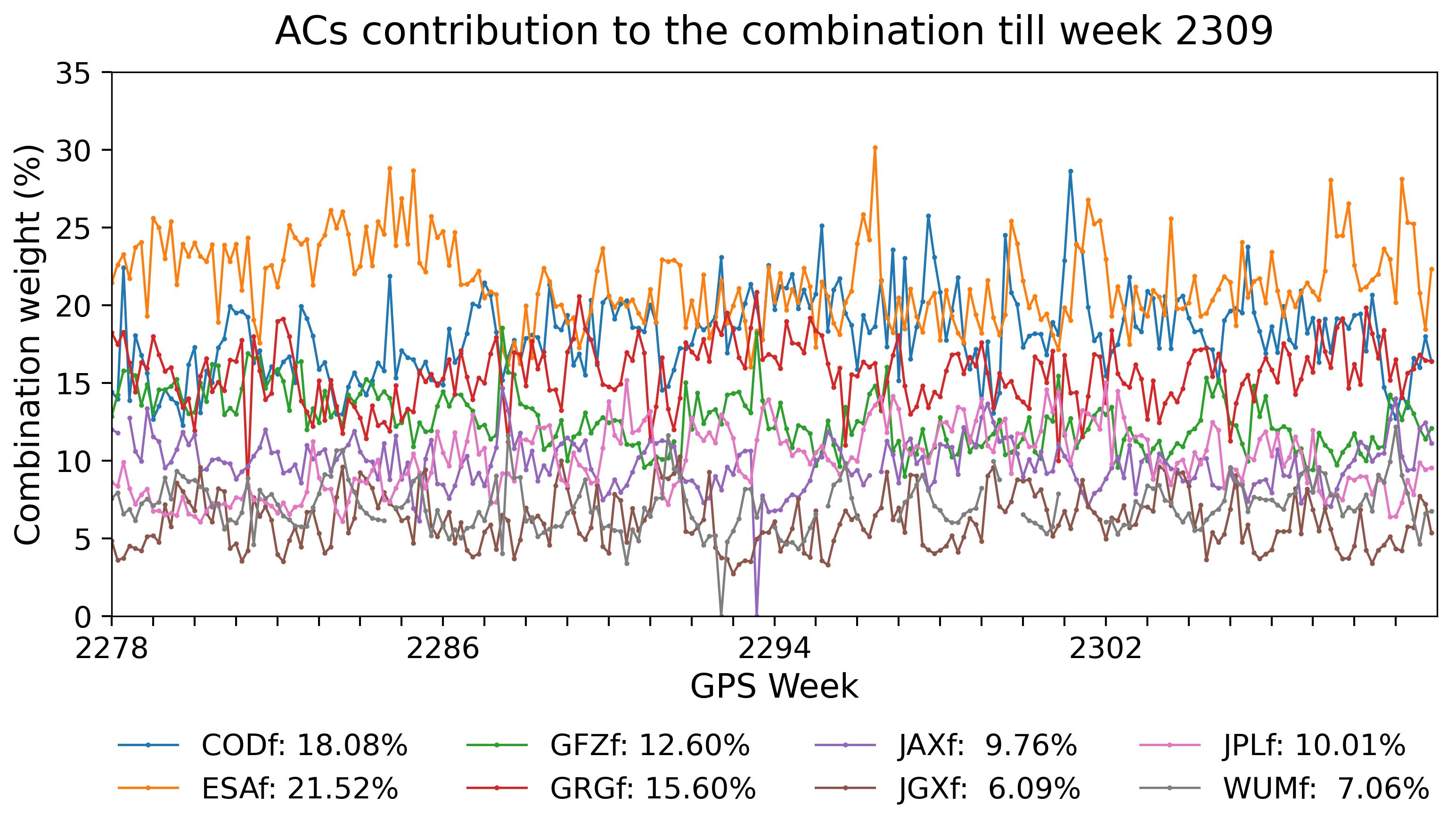
The combination weight
The clock combination employs an iterative weighting method in which the weight assigned to a specific product depends on its residuals in relation to the combined clock.
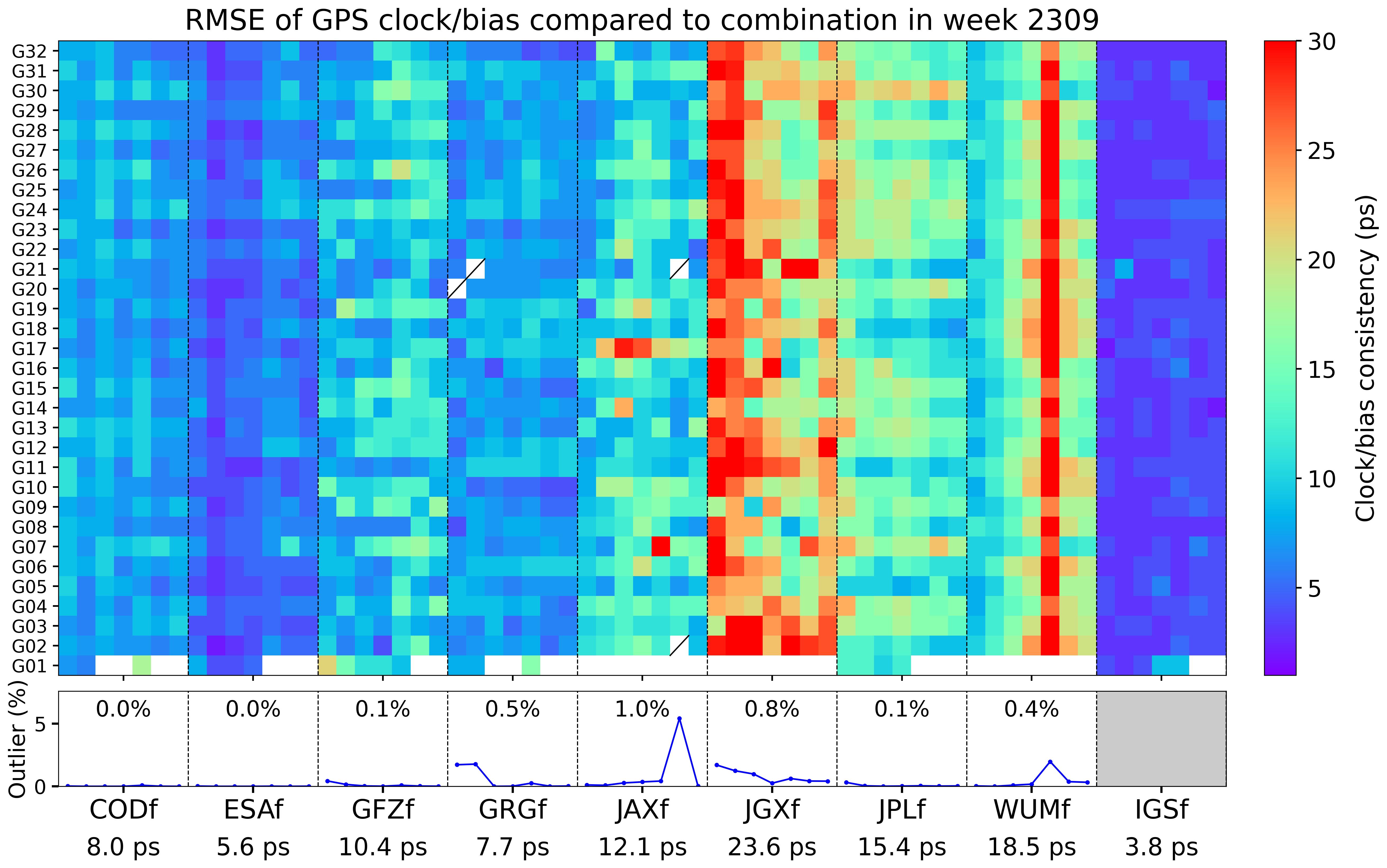
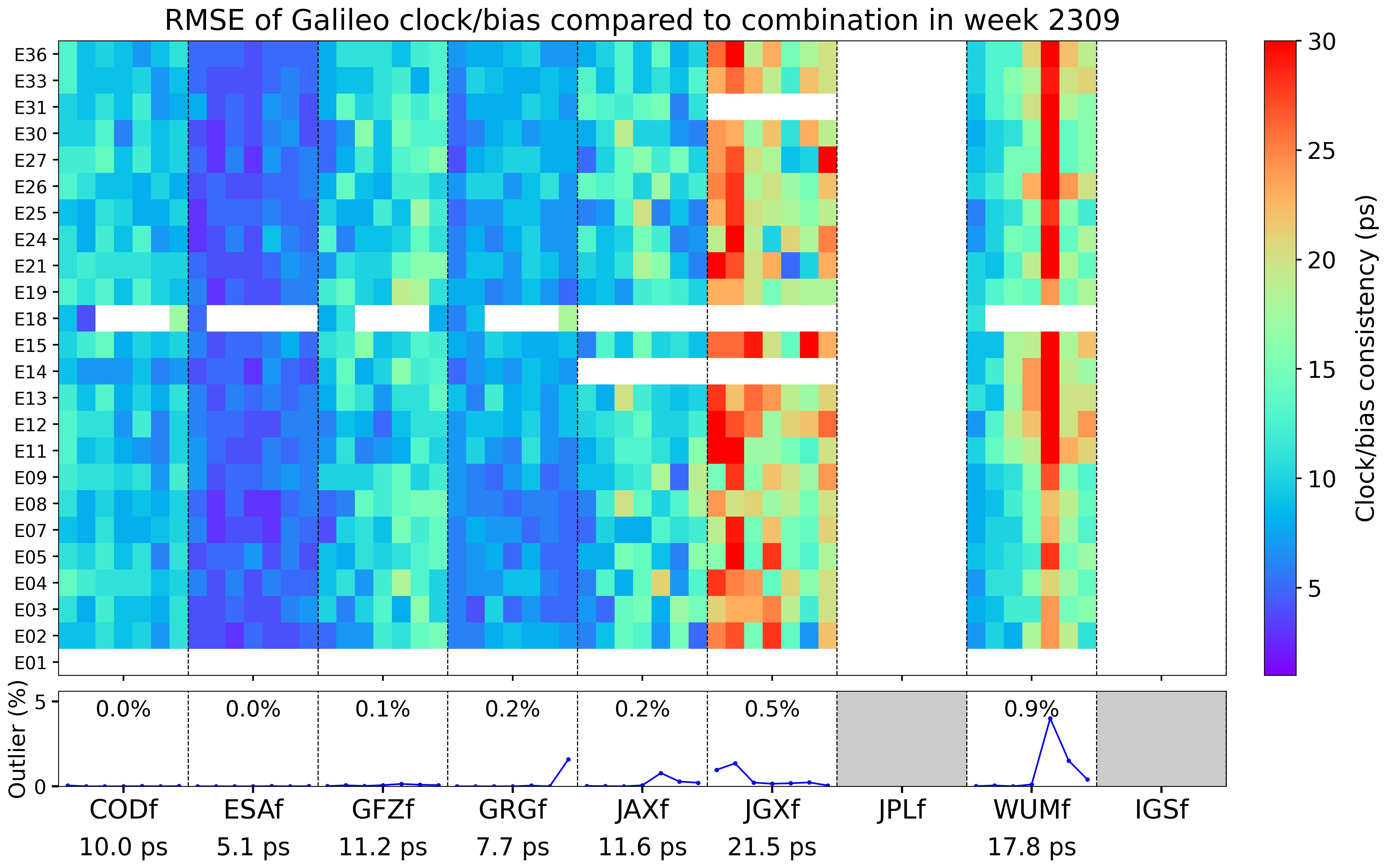
The weekly clock/bias RMSE
The clock/bias RMSE refers to the daily RMSE of clock/bias for each AC with respect to the combined integer clock, which reflects the precision of clock and bias combination and the consistency between individual ACs. Each grid represents a satellite on a particular day. Blank grids mean unavailable products and a slash inside means an outlier excluded from the combination. The line chart below shows the satellite clock outlier rate per day for each AC, with gray block indicating that relevant satellite clocks do not participate in the comparison. The statistics at the bottom indicate the overall RMSE of AC clock/bias for this week.

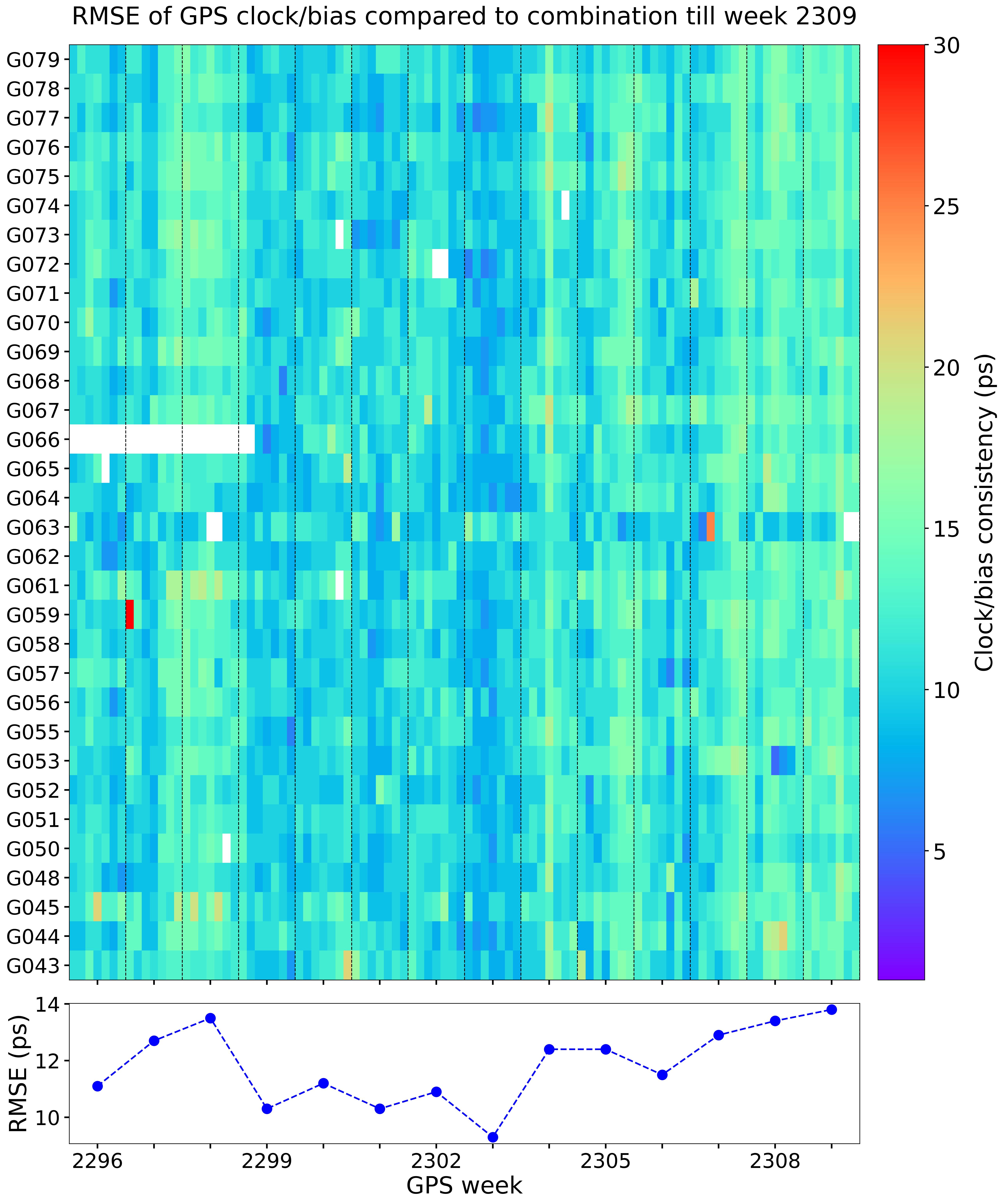
The accumulated clock/bias RMSE
The accumulated clock/bias RMSE refers to the daily RMSE of clock/bias series for all the ACs with respect to the combined integer clock, which reflects the change of the combined accuracy over time. The line chart below shows the overall RMSE for each constellation.
PPP-AR validation
The GPS/Galileo/BDS data with a sampling interval of 300 s from 10 globally distributed stations are processed for PPP-AR in a static mode with the PRIDE PPP-AR software. The fixing rate and position precision of each single constellation solution are presented in the figure below. IGS daily SINEX products are used as reference solution. “CMBf” stands for the combined final products.
Receiver atomic clocks
The epoch-to-epoch differences of receiver clock offsets represent the variation of receiver clocks between two consecutive epochs, which directly reflects the clock stability. The polyline segments in different colors represent different ACs, and “CMBr” stands for the combined products.
Last Updated on 1 Apr 2026 00:48 UTC